English · Organic Search + AI Search
Organic Search & AI Search Visibility Playbook for Global Ecommerce
Building official website page assets that win Google traffic, AI citations, leads, and orders
Version: V3 Full English Content Edition
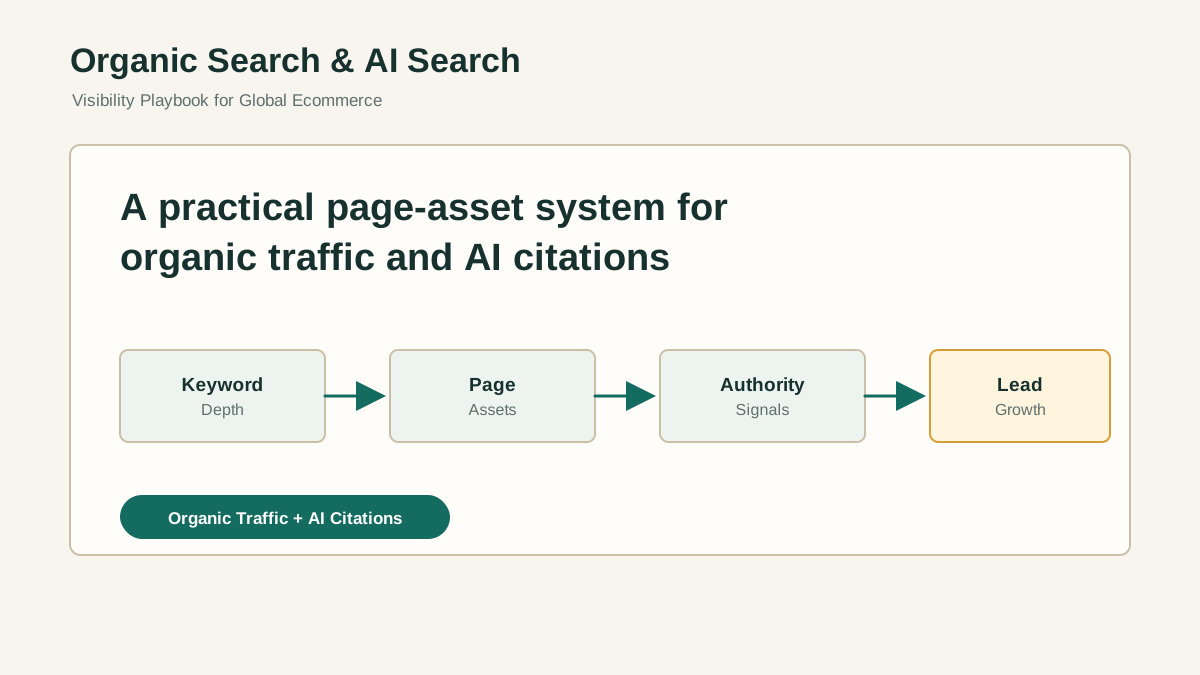
Opening: Overseas buyers will not find you unless your website becomes an entrance
Many global ecommerce sites do not lose because the product is weak. They lose because buyers never meet the brand in Google search results or AI answers. Ads can create short-term exposure, and marketplaces can rent existing demand, but the official website is the only asset that can keep compounding after the budget stops.
This playbook is about turning the official website into a page-asset system: keyword demand becomes pages, pages become indexable and rankable entrances, structured content becomes AI-readable evidence, and internal links, external trust signals, rankings, AI citations, and conversion paths work together.
Part 1: Decide whether this business is worth scaling through organic demand
Before building pages, the first decision is whether the category has enough search demand, enough commercial intent, and enough website-side conversion capacity. A weak category can still advertise, but it may not deserve a large page-asset investment yet.
The right starting point is not a template or a content calendar. It is a business judgment: can this product category be split into many useful search intents, and can those intents become pages that move visitors toward leads, quotes, wholesale inquiries, samples, or orders?
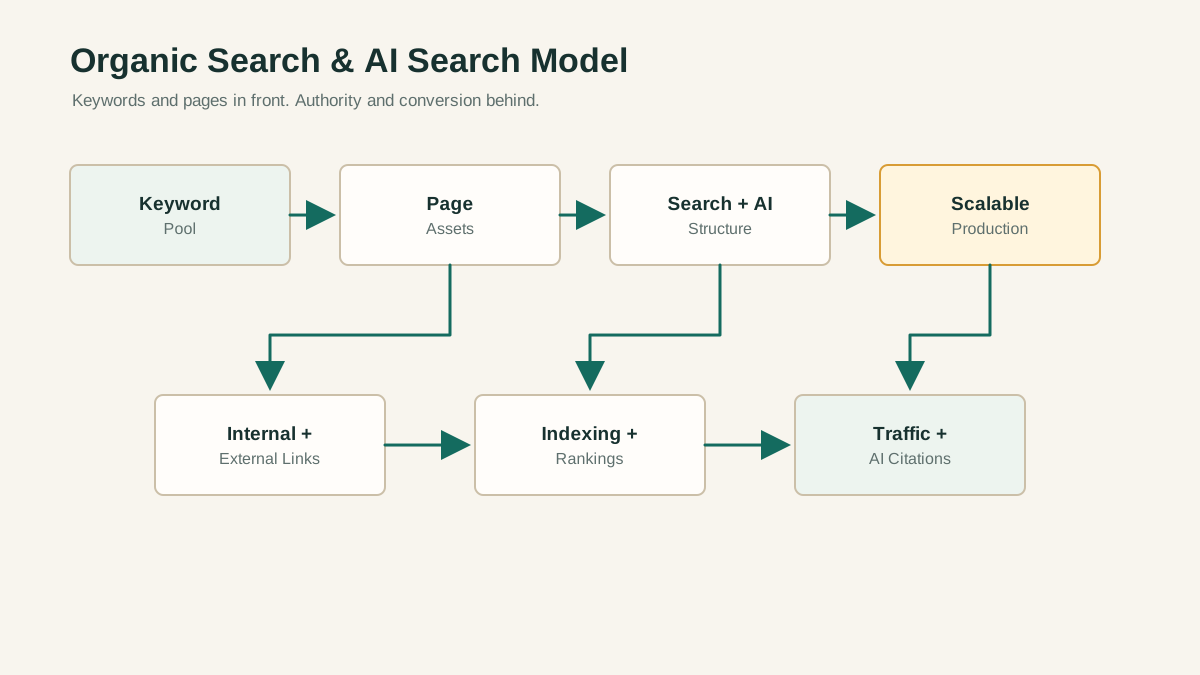
Chapter 1: Will overseas buyers actually search for this category?
A category is a strong candidate when buyers search by product, specification, use case, country, problem, comparison, recommendation, and supplier identity. If search demand only exists around a few broad keywords, the ceiling is limited.
Do not judge the opportunity only by one head term. In B2B, industrial products, auto parts, beauty, lighting, energy storage, and export manufacturing, the best demand often sits in commercial long-tail searches that tools undercount.
For a global ecommerce company, search demand should be treated as a business decision before it becomes a content task. The team should ask what kind of buyer this topic attracts, how close that buyer is to a real sourcing decision, and whether the official website can give that buyer a useful next step. If the answer is unclear, adding more pages will only make the site larger, not stronger.
In practical work, the useful starting point is to look for repeated patterns in category validation, buyer language, and commercial long-tail terms. A page asset should not exist only because a keyword tool shows a number. It should exist because the visitor has a specific question, a specific comparison, a specific use case, or a specific buying situation that the business can answer better than a generic article.
The page then needs to connect back into the whole acquisition system. It should point visitors toward related categories, products, cases, specifications, questions, and contact actions. It should also give search engines and AI systems enough clear context to understand what the company sells, who it serves, why the page is useful, and what evidence supports the recommendation.
The common mistake is to judge search demand in isolation. A page may look good by itself but still fail if it has no internal links, no conversion route, no relationship to other pages, and no external trust signals. A strong official website does not win because one page is perfect. It wins because many useful pages reinforce each other over time.
The owner-level judgment is simple: keep expanding when the page type shows signs of being indexable, understandable, rankable, citable, and commercially useful. Slow down when the pages are only increasing URL count. In this playbook, scale is valuable only when it creates more valid entrances into the business.
Chapter 2: Your website is not a showroom. It must turn visits into leads.
Organic traffic has value only when the site can convert it. The website needs product clarity, use-case clarity, trust information, company proof, contact paths, quote paths, and next-step actions.
If visitors finish reading a page and do not know what product to view, what solution fits them, or how to ask for a quote, traffic will leak. Conversion capacity should be checked before page volume is scaled.
For a global ecommerce company, conversion capacity should be treated as a business decision before it becomes a content task. The team should ask what kind of buyer this topic attracts, how close that buyer is to a real sourcing decision, and whether the official website can give that buyer a useful next step. If the answer is unclear, adding more pages will only make the site larger, not stronger.
In practical work, the useful starting point is to look for repeated patterns in official website experience, inquiry path, and quote and sample requests. A page asset should not exist only because a keyword tool shows a number. It should exist because the visitor has a specific question, a specific comparison, a specific use case, or a specific buying situation that the business can answer better than a generic article.
The page then needs to connect back into the whole acquisition system. It should point visitors toward related categories, products, cases, specifications, questions, and contact actions. It should also give search engines and AI systems enough clear context to understand what the company sells, who it serves, why the page is useful, and what evidence supports the recommendation.
The common mistake is to judge conversion capacity in isolation. A page may look good by itself but still fail if it has no internal links, no conversion route, no relationship to other pages, and no external trust signals. A strong official website does not win because one page is perfect. It wins because many useful pages reinforce each other over time.
The owner-level judgment is simple: keep expanding when the page type shows signs of being indexable, understandable, rankable, citable, and commercially useful. Slow down when the pages are only increasing URL count. In this playbook, scale is valuable only when it creates more valid entrances into the business.
Chapter 3: Not every keyword deserves its own page
A keyword becomes a page only when it has clear intent, independent content value, and a business path. Some keywords should be merged into one stronger page; some similar-looking terms should be split because the intent is different.
The goal is not one page per keyword. The goal is one useful page per meaningful search need. This distinction prevents scale from becoming low-quality URL generation.
For a global ecommerce company, keyword-to-page decisions should be treated as a business decision before it becomes a content task. The team should ask what kind of buyer this topic attracts, how close that buyer is to a real sourcing decision, and whether the official website can give that buyer a useful next step. If the answer is unclear, adding more pages will only make the site larger, not stronger.
In practical work, the useful starting point is to look for repeated patterns in intent separation, content consolidation, and duplicate risk. A page asset should not exist only because a keyword tool shows a number. It should exist because the visitor has a specific question, a specific comparison, a specific use case, or a specific buying situation that the business can answer better than a generic article.
The page then needs to connect back into the whole acquisition system. It should point visitors toward related categories, products, cases, specifications, questions, and contact actions. It should also give search engines and AI systems enough clear context to understand what the company sells, who it serves, why the page is useful, and what evidence supports the recommendation.
The common mistake is to judge keyword-to-page decisions in isolation. A page may look good by itself but still fail if it has no internal links, no conversion route, no relationship to other pages, and no external trust signals. A strong official website does not win because one page is perfect. It wins because many useful pages reinforce each other over time.
The owner-level judgment is simple: keep expanding when the page type shows signs of being indexable, understandable, rankable, citable, and commercially useful. Slow down when the pages are only increasing URL count. In this playbook, scale is valuable only when it creates more valid entrances into the business.
Chapter 4: Page count matters only when entrances form a network
Page volume is not the number of URLs in a system. It is the number of entrances that can be discovered, indexed, ranked, cited, and converted.
Useful page volume requires page types, internal links, product paths, and business roles. Product pages, scenario pages, question pages, comparison pages, supplier pages, and case pages need to support each other.
For a global ecommerce company, page asset volume should be treated as a business decision before it becomes a content task. The team should ask what kind of buyer this topic attracts, how close that buyer is to a real sourcing decision, and whether the official website can give that buyer a useful next step. If the answer is unclear, adding more pages will only make the site larger, not stronger.
In practical work, the useful starting point is to look for repeated patterns in internal connection, entry network, and compounding traffic. A page asset should not exist only because a keyword tool shows a number. It should exist because the visitor has a specific question, a specific comparison, a specific use case, or a specific buying situation that the business can answer better than a generic article.
The page then needs to connect back into the whole acquisition system. It should point visitors toward related categories, products, cases, specifications, questions, and contact actions. It should also give search engines and AI systems enough clear context to understand what the company sells, who it serves, why the page is useful, and what evidence supports the recommendation.
The common mistake is to judge page asset volume in isolation. A page may look good by itself but still fail if it has no internal links, no conversion route, no relationship to other pages, and no external trust signals. A strong official website does not win because one page is perfect. It wins because many useful pages reinforce each other over time.
The owner-level judgment is simple: keep expanding when the page type shows signs of being indexable, understandable, rankable, citable, and commercially useful. Slow down when the pages are only increasing URL count. In this playbook, scale is valuable only when it creates more valid entrances into the business.
Chapter 5: Why SEO and AI search visibility can use the same website assets
Google needs pages that match search intent. AI systems need pages with clear definitions, entities, evidence, comparisons, FAQs, cases, and trustworthy source signals. The front-end content structure overlaps heavily.
The efficient approach is not one content track for SEO and another for AI. Build official website pages that are searchable, understandable, citable, and convertible from the start.
For a global ecommerce company, shared page assets should be treated as a business decision before it becomes a content task. The team should ask what kind of buyer this topic attracts, how close that buyer is to a real sourcing decision, and whether the official website can give that buyer a useful next step. If the answer is unclear, adding more pages will only make the site larger, not stronger.
In practical work, the useful starting point is to look for repeated patterns in search ranking, AI citation readiness, and structured evidence. A page asset should not exist only because a keyword tool shows a number. It should exist because the visitor has a specific question, a specific comparison, a specific use case, or a specific buying situation that the business can answer better than a generic article.
The page then needs to connect back into the whole acquisition system. It should point visitors toward related categories, products, cases, specifications, questions, and contact actions. It should also give search engines and AI systems enough clear context to understand what the company sells, who it serves, why the page is useful, and what evidence supports the recommendation.
The common mistake is to judge shared page assets in isolation. A page may look good by itself but still fail if it has no internal links, no conversion route, no relationship to other pages, and no external trust signals. A strong official website does not win because one page is perfect. It wins because many useful pages reinforce each other over time.
The owner-level judgment is simple: keep expanding when the page type shows signs of being indexable, understandable, rankable, citable, and commercially useful. Slow down when the pages are only increasing URL count. In this playbook, scale is valuable only when it creates more valid entrances into the business.
Part 2: Turn search demand into a commercial keyword map
A keyword library is not a spreadsheet for reporting. It is a demand map that tells the team which needs exist, which needs deserve pages, which pages have commercial value, and which directions should be validated first.
The keyword map is the foundation of page volume, indexation volume, ranking volume, AI citation opportunities, and conversion volume.
Chapter 6: A keyword library is a customer demand map
Useful keyword research starts by grouping demand into product, attribute, scenario, region, problem, comparison, recommendation, and purchasing intent. These layers show how buyers think.
Search volume alone is not enough. A lower-volume term with strong purchase intent can be more valuable than a large informational keyword that never becomes a lead.
For a global ecommerce company, keyword library should be treated as a business decision before it becomes a content task. The team should ask what kind of buyer this topic attracts, how close that buyer is to a real sourcing decision, and whether the official website can give that buyer a useful next step. If the answer is unclear, adding more pages will only make the site larger, not stronger.
In practical work, the useful starting point is to look for repeated patterns in demand grouping, buyer intent, and commercial mapping. A page asset should not exist only because a keyword tool shows a number. It should exist because the visitor has a specific question, a specific comparison, a specific use case, or a specific buying situation that the business can answer better than a generic article.
The page then needs to connect back into the whole acquisition system. It should point visitors toward related categories, products, cases, specifications, questions, and contact actions. It should also give search engines and AI systems enough clear context to understand what the company sells, who it serves, why the page is useful, and what evidence supports the recommendation.
The common mistake is to judge keyword library in isolation. A page may look good by itself but still fail if it has no internal links, no conversion route, no relationship to other pages, and no external trust signals. A strong official website does not win because one page is perfect. It wins because many useful pages reinforce each other over time.
The owner-level judgment is simple: keep expanding when the page type shows signs of being indexable, understandable, rankable, citable, and commercially useful. Slow down when the pages are only increasing URL count. In this playbook, scale is valuable only when it creates more valid entrances into the business.
Chapter 7: From product terms to scenario terms
Product terms establish the category baseline. Attribute terms capture specifications, materials, sizes, power, capacity, colors, compatibility, or other buying criteria. Scenario terms reveal how the product is used.
Scenario terms are often where global ecommerce growth opens up. They connect the product to a real problem, a real space, a real device, or a real buyer situation.
For a global ecommerce company, scenario terms should be treated as a business decision before it becomes a content task. The team should ask what kind of buyer this topic attracts, how close that buyer is to a real sourcing decision, and whether the official website can give that buyer a useful next step. If the answer is unclear, adding more pages will only make the site larger, not stronger.
In practical work, the useful starting point is to look for repeated patterns in product attributes, use cases, and buyer situations. A page asset should not exist only because a keyword tool shows a number. It should exist because the visitor has a specific question, a specific comparison, a specific use case, or a specific buying situation that the business can answer better than a generic article.
The page then needs to connect back into the whole acquisition system. It should point visitors toward related categories, products, cases, specifications, questions, and contact actions. It should also give search engines and AI systems enough clear context to understand what the company sells, who it serves, why the page is useful, and what evidence supports the recommendation.
The common mistake is to judge scenario terms in isolation. A page may look good by itself but still fail if it has no internal links, no conversion route, no relationship to other pages, and no external trust signals. A strong official website does not win because one page is perfect. It wins because many useful pages reinforce each other over time.
The owner-level judgment is simple: keep expanding when the page type shows signs of being indexable, understandable, rankable, citable, and commercially useful. Slow down when the pages are only increasing URL count. In this playbook, scale is valuable only when it creates more valid entrances into the business.
Chapter 8: Region, comparison, recommendation, and purchasing terms define the commercial ceiling
Region terms help capture local buying intent. Comparison terms serve users who are choosing between options. Recommendation terms place the brand in best, top, and recommended contexts. Purchasing terms reveal supplier, manufacturer, wholesale, quote, and OEM demand.
These layers matter because they move beyond awareness. They capture buyers who are closer to choosing, sourcing, or requesting a quote.
For a global ecommerce company, commercial modifiers should be treated as a business decision before it becomes a content task. The team should ask what kind of buyer this topic attracts, how close that buyer is to a real sourcing decision, and whether the official website can give that buyer a useful next step. If the answer is unclear, adding more pages will only make the site larger, not stronger.
In practical work, the useful starting point is to look for repeated patterns in regional intent, comparison pages, and supplier and wholesale demand. A page asset should not exist only because a keyword tool shows a number. It should exist because the visitor has a specific question, a specific comparison, a specific use case, or a specific buying situation that the business can answer better than a generic article.
The page then needs to connect back into the whole acquisition system. It should point visitors toward related categories, products, cases, specifications, questions, and contact actions. It should also give search engines and AI systems enough clear context to understand what the company sells, who it serves, why the page is useful, and what evidence supports the recommendation.
The common mistake is to judge commercial modifiers in isolation. A page may look good by itself but still fail if it has no internal links, no conversion route, no relationship to other pages, and no external trust signals. A strong official website does not win because one page is perfect. It wins because many useful pages reinforce each other over time.
The owner-level judgment is simple: keep expanding when the page type shows signs of being indexable, understandable, rankable, citable, and commercially useful. Slow down when the pages are only increasing URL count. In this playbook, scale is valuable only when it creates more valid entrances into the business.
Chapter 9: Which keywords should become pages and which should be merged?
A keyword should become a page when it has a distinct intent, a meaningful answer, and a conversion path. If several keywords share the same intent, they should usually be consolidated into a stronger page.
The page decision should be based on user intent, not mechanical keyword counts. This is how scale stays useful instead of becoming duplicate content.
For a global ecommerce company, page mapping should be treated as a business decision before it becomes a content task. The team should ask what kind of buyer this topic attracts, how close that buyer is to a real sourcing decision, and whether the official website can give that buyer a useful next step. If the answer is unclear, adding more pages will only make the site larger, not stronger.
In practical work, the useful starting point is to look for repeated patterns in intent clusters, merge decisions, and stronger landing pages. A page asset should not exist only because a keyword tool shows a number. It should exist because the visitor has a specific question, a specific comparison, a specific use case, or a specific buying situation that the business can answer better than a generic article.
The page then needs to connect back into the whole acquisition system. It should point visitors toward related categories, products, cases, specifications, questions, and contact actions. It should also give search engines and AI systems enough clear context to understand what the company sells, who it serves, why the page is useful, and what evidence supports the recommendation.
The common mistake is to judge page mapping in isolation. A page may look good by itself but still fail if it has no internal links, no conversion route, no relationship to other pages, and no external trust signals. A strong official website does not win because one page is perfect. It wins because many useful pages reinforce each other over time.
The owner-level judgment is simple: keep expanding when the page type shows signs of being indexable, understandable, rankable, citable, and commercially useful. Slow down when the pages are only increasing URL count. In this playbook, scale is valuable only when it creates more valid entrances into the business.
Chapter 10: Does the keyword have a lead, quote, or order path?
A keyword can bring traffic but still fail commercially. The team must judge whether the visitor can move from the page into product selection, inquiry, quote request, sample request, wholesale discussion, distributor contact, or purchase.
Commercial intent is not limited to obvious buying words. Selection, comparison, compatibility, and problem-solving searches can also become leads when the page guides the user correctly.
For a global ecommerce company, commercial path should be treated as a business decision before it becomes a content task. The team should ask what kind of buyer this topic attracts, how close that buyer is to a real sourcing decision, and whether the official website can give that buyer a useful next step. If the answer is unclear, adding more pages will only make the site larger, not stronger.
In practical work, the useful starting point is to look for repeated patterns in lead intent, product selection, and conversion routing. A page asset should not exist only because a keyword tool shows a number. It should exist because the visitor has a specific question, a specific comparison, a specific use case, or a specific buying situation that the business can answer better than a generic article.
The page then needs to connect back into the whole acquisition system. It should point visitors toward related categories, products, cases, specifications, questions, and contact actions. It should also give search engines and AI systems enough clear context to understand what the company sells, who it serves, why the page is useful, and what evidence supports the recommendation.
The common mistake is to judge commercial path in isolation. A page may look good by itself but still fail if it has no internal links, no conversion route, no relationship to other pages, and no external trust signals. A strong official website does not win because one page is perfect. It wins because many useful pages reinforce each other over time.
The owner-level judgment is simple: keep expanding when the page type shows signs of being indexable, understandable, rankable, citable, and commercially useful. Slow down when the pages are only increasing URL count. In this playbook, scale is valuable only when it creates more valid entrances into the business.
Chapter 11: Keyword volume reveals the project ceiling
If a category can only produce a few hundred useful terms, it may still be worth optimizing, but it should not be sold as a massive organic growth system. If the category can produce tens of thousands of page-worthy combinations, the ceiling is very different.
The key judgment is not only quantity. The keyword universe must be pageable, indexable, rankable, citable, and convertible.
For a global ecommerce company, demand ceiling should be treated as a business decision before it becomes a content task. The team should ask what kind of buyer this topic attracts, how close that buyer is to a real sourcing decision, and whether the official website can give that buyer a useful next step. If the answer is unclear, adding more pages will only make the site larger, not stronger.
In practical work, the useful starting point is to look for repeated patterns in volume distribution, market depth, and growth potential. A page asset should not exist only because a keyword tool shows a number. It should exist because the visitor has a specific question, a specific comparison, a specific use case, or a specific buying situation that the business can answer better than a generic article.
The page then needs to connect back into the whole acquisition system. It should point visitors toward related categories, products, cases, specifications, questions, and contact actions. It should also give search engines and AI systems enough clear context to understand what the company sells, who it serves, why the page is useful, and what evidence supports the recommendation.
The common mistake is to judge demand ceiling in isolation. A page may look good by itself but still fail if it has no internal links, no conversion route, no relationship to other pages, and no external trust signals. A strong official website does not win because one page is perfect. It wins because many useful pages reinforce each other over time.
The owner-level judgment is simple: keep expanding when the page type shows signs of being indexable, understandable, rankable, citable, and commercially useful. Slow down when the pages are only increasing URL count. In this playbook, scale is valuable only when it creates more valid entrances into the business.
Part 3: Turn keywords into pages that Google and AI can trust
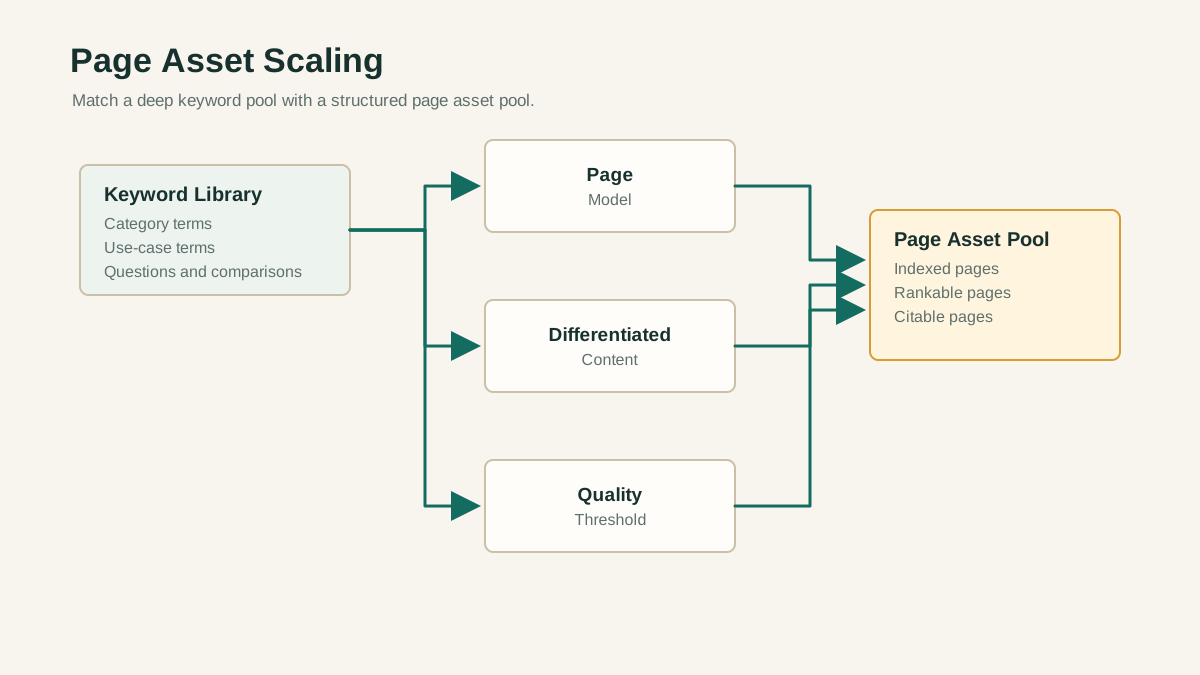
Keywords are opportunities. Pages are entrances. Without pages, demand remains in a spreadsheet. With the right pages, demand can enter Google indexation, rankings, AI citations, and conversion paths.
A page asset is not a thin article. It is a structured official website page with a clear role in search, AI understanding, and business conversion.
Chapter 12: Valuable page volume means valid entrances, not URL count
A valid entrance has search demand, unique value, crawlable structure, internal links, and a next step. A URL without those qualities is not an asset.
The larger the page system becomes, the more important structure becomes. Scale requires discipline, not random generation.
For a global ecommerce company, valid entrances should be treated as a business decision before it becomes a content task. The team should ask what kind of buyer this topic attracts, how close that buyer is to a real sourcing decision, and whether the official website can give that buyer a useful next step. If the answer is unclear, adding more pages will only make the site larger, not stronger.
In practical work, the useful starting point is to look for repeated patterns in indexable pages, rankable assets, and quality threshold. A page asset should not exist only because a keyword tool shows a number. It should exist because the visitor has a specific question, a specific comparison, a specific use case, or a specific buying situation that the business can answer better than a generic article.
The page then needs to connect back into the whole acquisition system. It should point visitors toward related categories, products, cases, specifications, questions, and contact actions. It should also give search engines and AI systems enough clear context to understand what the company sells, who it serves, why the page is useful, and what evidence supports the recommendation.
The common mistake is to judge valid entrances in isolation. A page may look good by itself but still fail if it has no internal links, no conversion route, no relationship to other pages, and no external trust signals. A strong official website does not win because one page is perfect. It wins because many useful pages reinforce each other over time.
The owner-level judgment is simple: keep expanding when the page type shows signs of being indexable, understandable, rankable, citable, and commercially useful. Slow down when the pages are only increasing URL count. In this playbook, scale is valuable only when it creates more valid entrances into the business.
Chapter 13: What product, category, attribute, and scenario pages each do
Product and category pages carry the commercial foundation. Attribute pages help users choose based on specifications. Scenario pages connect the product to a real use case and often bring strong long-tail traffic.
These page types should not compete with each other. They should point users toward the right product or solution path.
For a global ecommerce company, page roles should be treated as a business decision before it becomes a content task. The team should ask what kind of buyer this topic attracts, how close that buyer is to a real sourcing decision, and whether the official website can give that buyer a useful next step. If the answer is unclear, adding more pages will only make the site larger, not stronger.
In practical work, the useful starting point is to look for repeated patterns in category coverage, attribute pages, and scenario pages. A page asset should not exist only because a keyword tool shows a number. It should exist because the visitor has a specific question, a specific comparison, a specific use case, or a specific buying situation that the business can answer better than a generic article.
The page then needs to connect back into the whole acquisition system. It should point visitors toward related categories, products, cases, specifications, questions, and contact actions. It should also give search engines and AI systems enough clear context to understand what the company sells, who it serves, why the page is useful, and what evidence supports the recommendation.
The common mistake is to judge page roles in isolation. A page may look good by itself but still fail if it has no internal links, no conversion route, no relationship to other pages, and no external trust signals. A strong official website does not win because one page is perfect. It wins because many useful pages reinforce each other over time.
The owner-level judgment is simple: keep expanding when the page type shows signs of being indexable, understandable, rankable, citable, and commercially useful. Slow down when the pages are only increasing URL count. In this playbook, scale is valuable only when it creates more valid entrances into the business.
Chapter 14: Question, comparison, recommendation, and purchasing pages support pre-sale decisions
Question pages answer doubts. Comparison pages help users choose. Recommendation pages place the brand in selection contexts. Purchasing pages serve supplier, wholesale, manufacturer, OEM, and quote intent.
These pages are especially useful for AI search because AI systems often answer questions, compare options, and recommend suppliers.
For a global ecommerce company, pre-sale pages should be treated as a business decision before it becomes a content task. The team should ask what kind of buyer this topic attracts, how close that buyer is to a real sourcing decision, and whether the official website can give that buyer a useful next step. If the answer is unclear, adding more pages will only make the site larger, not stronger.
In practical work, the useful starting point is to look for repeated patterns in questions, comparisons, and recommendation and purchasing intent. A page asset should not exist only because a keyword tool shows a number. It should exist because the visitor has a specific question, a specific comparison, a specific use case, or a specific buying situation that the business can answer better than a generic article.
The page then needs to connect back into the whole acquisition system. It should point visitors toward related categories, products, cases, specifications, questions, and contact actions. It should also give search engines and AI systems enough clear context to understand what the company sells, who it serves, why the page is useful, and what evidence supports the recommendation.
The common mistake is to judge pre-sale pages in isolation. A page may look good by itself but still fail if it has no internal links, no conversion route, no relationship to other pages, and no external trust signals. A strong official website does not win because one page is perfect. It wins because many useful pages reinforce each other over time.
The owner-level judgment is simple: keep expanding when the page type shows signs of being indexable, understandable, rankable, citable, and commercially useful. Slow down when the pages are only increasing URL count. In this playbook, scale is valuable only when it creates more valid entrances into the business.
Chapter 15: A good page must make sense to customers, Google, and AI
A strong page usually includes a clear definition, the target intent, relevant products, selection criteria, use cases, proof points, FAQs, internal links, and a conversion path.
The same structure helps users read, helps Google understand, and helps AI extract. This is why search and AI visibility should be planned together.
For a global ecommerce company, page quality should be treated as a business decision before it becomes a content task. The team should ask what kind of buyer this topic attracts, how close that buyer is to a real sourcing decision, and whether the official website can give that buyer a useful next step. If the answer is unclear, adding more pages will only make the site larger, not stronger.
In practical work, the useful starting point is to look for repeated patterns in customer clarity, search intent, and AI-readable structure. A page asset should not exist only because a keyword tool shows a number. It should exist because the visitor has a specific question, a specific comparison, a specific use case, or a specific buying situation that the business can answer better than a generic article.
The page then needs to connect back into the whole acquisition system. It should point visitors toward related categories, products, cases, specifications, questions, and contact actions. It should also give search engines and AI systems enough clear context to understand what the company sells, who it serves, why the page is useful, and what evidence supports the recommendation.
The common mistake is to judge page quality in isolation. A page may look good by itself but still fail if it has no internal links, no conversion route, no relationship to other pages, and no external trust signals. A strong official website does not win because one page is perfect. It wins because many useful pages reinforce each other over time.
The owner-level judgment is simple: keep expanding when the page type shows signs of being indexable, understandable, rankable, citable, and commercially useful. Slow down when the pages are only increasing URL count. In this playbook, scale is valuable only when it creates more valid entrances into the business.
Chapter 16: Scale does not create low quality. Lack of independent value does.
Many teams fear page volume because they confuse scale with spam. The real issue is not quantity. The issue is whether each page has a unique intent, useful information, and a role inside the website.
Do not publish pages just because they can be generated. Publish pages because they carry a real search need and a real business path.
For a global ecommerce company, scale quality should be treated as a business decision before it becomes a content task. The team should ask what kind of buyer this topic attracts, how close that buyer is to a real sourcing decision, and whether the official website can give that buyer a useful next step. If the answer is unclear, adding more pages will only make the site larger, not stronger.
In practical work, the useful starting point is to look for repeated patterns in independent value, thin content risk, and useful differentiation. A page asset should not exist only because a keyword tool shows a number. It should exist because the visitor has a specific question, a specific comparison, a specific use case, or a specific buying situation that the business can answer better than a generic article.
The page then needs to connect back into the whole acquisition system. It should point visitors toward related categories, products, cases, specifications, questions, and contact actions. It should also give search engines and AI systems enough clear context to understand what the company sells, who it serves, why the page is useful, and what evidence supports the recommendation.
The common mistake is to judge scale quality in isolation. A page may look good by itself but still fail if it has no internal links, no conversion route, no relationship to other pages, and no external trust signals. A strong official website does not win because one page is perfect. It wins because many useful pages reinforce each other over time.
The owner-level judgment is simple: keep expanding when the page type shows signs of being indexable, understandable, rankable, citable, and commercially useful. Slow down when the pages are only increasing URL count. In this playbook, scale is valuable only when it creates more valid entrances into the business.
Chapter 17: Validate sample pages before scaling
Before scaling thousands of pages, validate a smaller batch. Check whether the page type can be crawled, indexed, ranked, clicked, cited, and converted.
A validated model can be expanded. An unvalidated model should be improved before more pages are added.
For a global ecommerce company, sample validation should be treated as a business decision before it becomes a content task. The team should ask what kind of buyer this topic attracts, how close that buyer is to a real sourcing decision, and whether the official website can give that buyer a useful next step. If the answer is unclear, adding more pages will only make the site larger, not stronger.
In practical work, the useful starting point is to look for repeated patterns in pilot pages, early signal review, and scale readiness. A page asset should not exist only because a keyword tool shows a number. It should exist because the visitor has a specific question, a specific comparison, a specific use case, or a specific buying situation that the business can answer better than a generic article.
The page then needs to connect back into the whole acquisition system. It should point visitors toward related categories, products, cases, specifications, questions, and contact actions. It should also give search engines and AI systems enough clear context to understand what the company sells, who it serves, why the page is useful, and what evidence supports the recommendation.
The common mistake is to judge sample validation in isolation. A page may look good by itself but still fail if it has no internal links, no conversion route, no relationship to other pages, and no external trust signals. A strong official website does not win because one page is perfect. It wins because many useful pages reinforce each other over time.
The owner-level judgment is simple: keep expanding when the page type shows signs of being indexable, understandable, rankable, citable, and commercially useful. Slow down when the pages are only increasing URL count. In this playbook, scale is valuable only when it creates more valid entrances into the business.
Part 4: Help page assets get discovered, trusted, and recommended
Page assets need authority and discoverability. Internal links organize the site. External sources bring trust. Search engines and AI systems both depend on signals beyond the isolated page.
This is where SEO and AI search visibility again overlap. Both need credible, connected, consistent information.
Chapter 18: Technical scaling means amplifying validated demand, not flooding pages
Technology is useful when it helps turn validated keyword demand into consistent, crawlable, useful page assets. It becomes dangerous when it mass-produces pages before the model is proven.
The right boundary is simple: use technology to scale what is already valid, not to hide weak strategy under volume.
For a global ecommerce company, technical scaling should be treated as a business decision before it becomes a content task. The team should ask what kind of buyer this topic attracts, how close that buyer is to a real sourcing decision, and whether the official website can give that buyer a useful next step. If the answer is unclear, adding more pages will only make the site larger, not stronger.
In practical work, the useful starting point is to look for repeated patterns in validated demand, controlled expansion, and automation discipline. A page asset should not exist only because a keyword tool shows a number. It should exist because the visitor has a specific question, a specific comparison, a specific use case, or a specific buying situation that the business can answer better than a generic article.
The page then needs to connect back into the whole acquisition system. It should point visitors toward related categories, products, cases, specifications, questions, and contact actions. It should also give search engines and AI systems enough clear context to understand what the company sells, who it serves, why the page is useful, and what evidence supports the recommendation.
The common mistake is to judge technical scaling in isolation. A page may look good by itself but still fail if it has no internal links, no conversion route, no relationship to other pages, and no external trust signals. A strong official website does not win because one page is perfect. It wins because many useful pages reinforce each other over time.
The owner-level judgment is simple: keep expanding when the page type shows signs of being indexable, understandable, rankable, citable, and commercially useful. Slow down when the pages are only increasing URL count. In this playbook, scale is valuable only when it creates more valid entrances into the business.
Chapter 19: Internal links turn isolated pages into topic authority
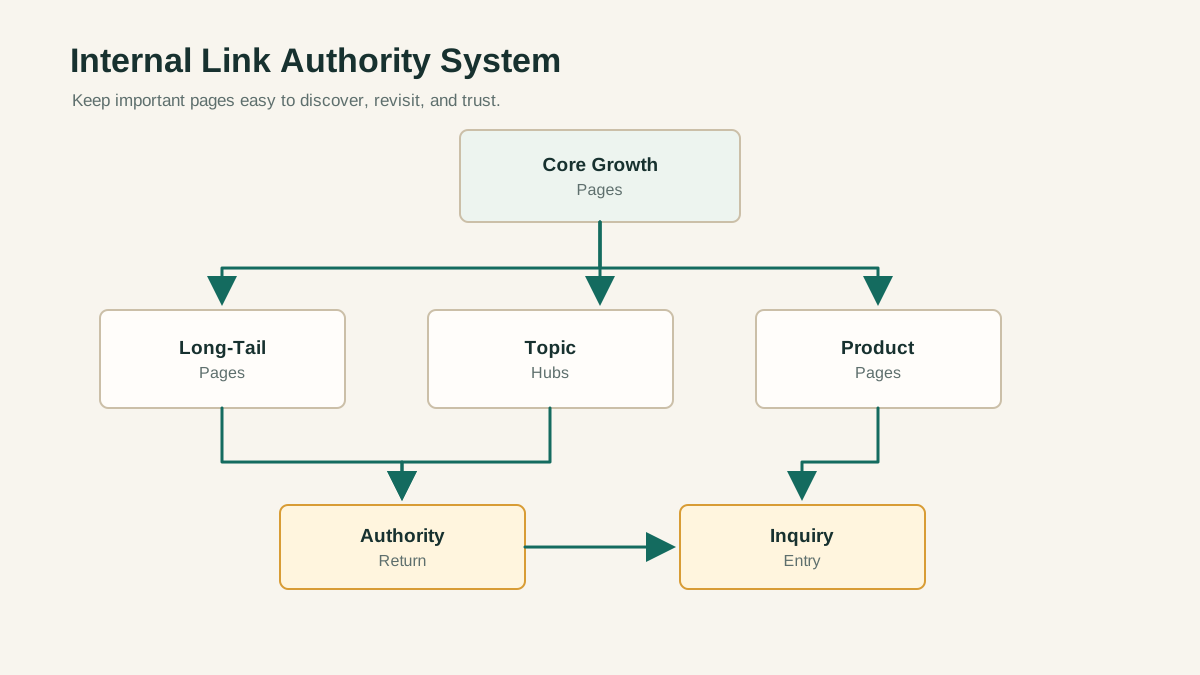
Internal links help Google discover pages, understand relationships, and distribute authority. They also help users move from informational pages to products, cases, and inquiries.
A strong internal link system connects core topic pages, hub pages, scenario pages, question pages, product pages, and inquiry paths.
For a global ecommerce company, internal links should be treated as a business decision before it becomes a content task. The team should ask what kind of buyer this topic attracts, how close that buyer is to a real sourcing decision, and whether the official website can give that buyer a useful next step. If the answer is unclear, adding more pages will only make the site larger, not stronger.
In practical work, the useful starting point is to look for repeated patterns in topic authority, orphan pages, and authority flow. A page asset should not exist only because a keyword tool shows a number. It should exist because the visitor has a specific question, a specific comparison, a specific use case, or a specific buying situation that the business can answer better than a generic article.
The page then needs to connect back into the whole acquisition system. It should point visitors toward related categories, products, cases, specifications, questions, and contact actions. It should also give search engines and AI systems enough clear context to understand what the company sells, who it serves, why the page is useful, and what evidence supports the recommendation.
The common mistake is to judge internal links in isolation. A page may look good by itself but still fail if it has no internal links, no conversion route, no relationship to other pages, and no external trust signals. A strong official website does not win because one page is perfect. It wins because many useful pages reinforce each other over time.
The owner-level judgment is simple: keep expanding when the page type shows signs of being indexable, understandable, rankable, citable, and commercially useful. Slow down when the pages are only increasing URL count. In this playbook, scale is valuable only when it creates more valid entrances into the business.
Chapter 20: External links and external sources bring trust into the official website
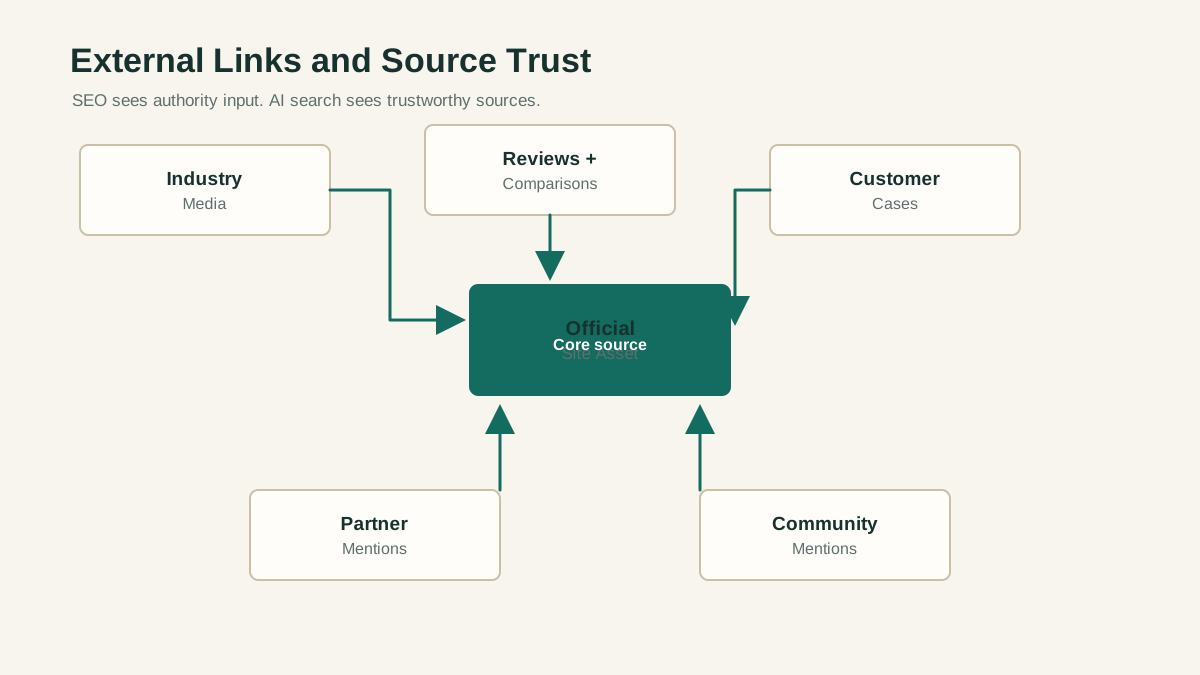
In traditional SEO, external links are authority input. In AI search, external sources also act as credibility evidence. Media, directories, reviews, comparisons, partners, cases, certifications, and industry mentions all matter.
The strongest signal is consistency. The official site, industry media, supplier profiles, reviews, and cases should describe the company, category, market, and capabilities in a consistent way.
For a global ecommerce company, external links should be treated as a business decision before it becomes a content task. The team should ask what kind of buyer this topic attracts, how close that buyer is to a real sourcing decision, and whether the official website can give that buyer a useful next step. If the answer is unclear, adding more pages will only make the site larger, not stronger.
In practical work, the useful starting point is to look for repeated patterns in source trust, brand mentions, and official-site authority. A page asset should not exist only because a keyword tool shows a number. It should exist because the visitor has a specific question, a specific comparison, a specific use case, or a specific buying situation that the business can answer better than a generic article.
The page then needs to connect back into the whole acquisition system. It should point visitors toward related categories, products, cases, specifications, questions, and contact actions. It should also give search engines and AI systems enough clear context to understand what the company sells, who it serves, why the page is useful, and what evidence supports the recommendation.
The common mistake is to judge external links in isolation. A page may look good by itself but still fail if it has no internal links, no conversion route, no relationship to other pages, and no external trust signals. A strong official website does not win because one page is perfect. It wins because many useful pages reinforce each other over time.
The owner-level judgment is simple: keep expanding when the page type shows signs of being indexable, understandable, rankable, citable, and commercially useful. Slow down when the pages are only increasing URL count. In this playbook, scale is valuable only when it creates more valid entrances into the business.
Chapter 21: The same authority signals can serve SEO and AI search visibility
Internal links help organize the website. External sources help confirm the company. Together they support rankings, trust, and AI recommendation contexts.
Do not treat link building as a separate SEO trick. It should support the same page clusters that need rankings, citations, and conversions.
For a global ecommerce company, authority signals should be treated as a business decision before it becomes a content task. The team should ask what kind of buyer this topic attracts, how close that buyer is to a real sourcing decision, and whether the official website can give that buyer a useful next step. If the answer is unclear, adding more pages will only make the site larger, not stronger.
In practical work, the useful starting point is to look for repeated patterns in shared trust, search engines, and AI source selection. A page asset should not exist only because a keyword tool shows a number. It should exist because the visitor has a specific question, a specific comparison, a specific use case, or a specific buying situation that the business can answer better than a generic article.
The page then needs to connect back into the whole acquisition system. It should point visitors toward related categories, products, cases, specifications, questions, and contact actions. It should also give search engines and AI systems enough clear context to understand what the company sells, who it serves, why the page is useful, and what evidence supports the recommendation.
The common mistake is to judge authority signals in isolation. A page may look good by itself but still fail if it has no internal links, no conversion route, no relationship to other pages, and no external trust signals. A strong official website does not win because one page is perfect. It wins because many useful pages reinforce each other over time.
The owner-level judgment is simple: keep expanding when the page type shows signs of being indexable, understandable, rankable, citable, and commercially useful. Slow down when the pages are only increasing URL count. In this playbook, scale is valuable only when it creates more valid entrances into the business.
Chapter 22: Review indexation, rankings, citations, and conversion together
Traffic alone is not enough. Indexation shows whether pages entered Google. Rankings show whether pages became competitive. AI citations show whether pages became information sources. Conversion shows whether traffic became business.
A page type should be scaled only when the combined signals make sense.
For a global ecommerce company, monthly review should be treated as a business decision before it becomes a content task. The team should ask what kind of buyer this topic attracts, how close that buyer is to a real sourcing decision, and whether the official website can give that buyer a useful next step. If the answer is unclear, adding more pages will only make the site larger, not stronger.
In practical work, the useful starting point is to look for repeated patterns in indexation, rankings and citations, and conversion data. A page asset should not exist only because a keyword tool shows a number. It should exist because the visitor has a specific question, a specific comparison, a specific use case, or a specific buying situation that the business can answer better than a generic article.
The page then needs to connect back into the whole acquisition system. It should point visitors toward related categories, products, cases, specifications, questions, and contact actions. It should also give search engines and AI systems enough clear context to understand what the company sells, who it serves, why the page is useful, and what evidence supports the recommendation.
The common mistake is to judge monthly review in isolation. A page may look good by itself but still fail if it has no internal links, no conversion route, no relationship to other pages, and no external trust signals. A strong official website does not win because one page is perfect. It wins because many useful pages reinforce each other over time.
The owner-level judgment is simple: keep expanding when the page type shows signs of being indexable, understandable, rankable, citable, and commercially useful. Slow down when the pages are only increasing URL count. In this playbook, scale is valuable only when it creates more valid entrances into the business.
Part 5: Four industry examples
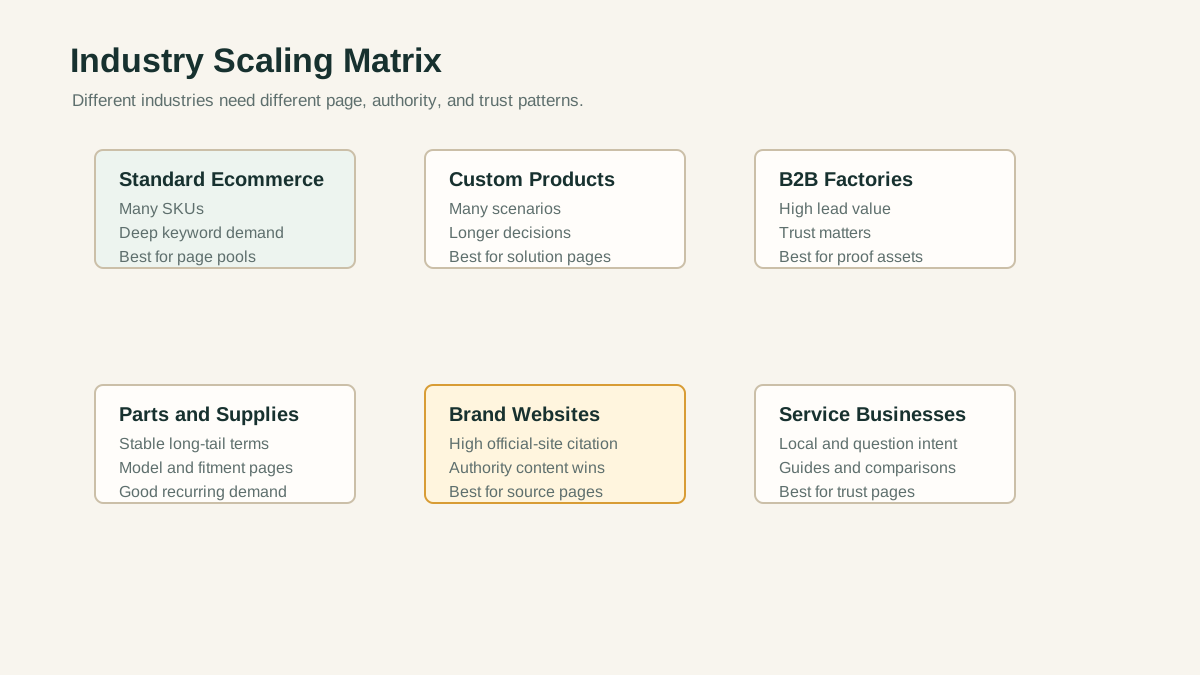
Different categories require different keyword dimensions, but the growth logic stays the same: demand becomes keywords, keywords become pages, pages enter rankings and AI answers, and conversion paths turn visibility into leads.
The examples below show how the model changes by category.
Chapter 23: LED lighting: grow from engineering scenarios
LED lighting can expand by product type, scenario, specification, installation need, supplier identity, and project case. Hotel lighting, warehouse lighting, outdoor lighting, retail lighting, and factory lighting each deserve different content.
The common mistake is writing every page as a product specification. Buyers need scenario judgment, installation guidance, product matching, and proof of delivery capacity.
For a global ecommerce company, LED lighting should be treated as a business decision before it becomes a content task. The team should ask what kind of buyer this topic attracts, how close that buyer is to a real sourcing decision, and whether the official website can give that buyer a useful next step. If the answer is unclear, adding more pages will only make the site larger, not stronger.
In practical work, the useful starting point is to look for repeated patterns in engineering scenarios, specification intent, and project buyers. A page asset should not exist only because a keyword tool shows a number. It should exist because the visitor has a specific question, a specific comparison, a specific use case, or a specific buying situation that the business can answer better than a generic article.
The page then needs to connect back into the whole acquisition system. It should point visitors toward related categories, products, cases, specifications, questions, and contact actions. It should also give search engines and AI systems enough clear context to understand what the company sells, who it serves, why the page is useful, and what evidence supports the recommendation.
The common mistake is to judge LED lighting in isolation. A page may look good by itself but still fail if it has no internal links, no conversion route, no relationship to other pages, and no external trust signals. A strong official website does not win because one page is perfect. It wins because many useful pages reinforce each other over time.
The owner-level judgment is simple: keep expanding when the page type shows signs of being indexable, understandable, rankable, citable, and commercially useful. Slow down when the pages are only increasing URL count. In this playbook, scale is valuable only when it creates more valid entrances into the business.
Chapter 24: Auto parts: use vehicle, year, part number, and problem searches
Auto parts demand is built around compatibility. Vehicle model, year, OE number, replacement number, symptom, installation issue, and supplier identity can create a large long-tail universe.
The website should become a compatibility knowledge network, not just a catalog.
For a global ecommerce company, auto parts should be treated as a business decision before it becomes a content task. The team should ask what kind of buyer this topic attracts, how close that buyer is to a real sourcing decision, and whether the official website can give that buyer a useful next step. If the answer is unclear, adding more pages will only make the site larger, not stronger.
In practical work, the useful starting point is to look for repeated patterns in fitment terms, part numbers, and problem searches. A page asset should not exist only because a keyword tool shows a number. It should exist because the visitor has a specific question, a specific comparison, a specific use case, or a specific buying situation that the business can answer better than a generic article.
The page then needs to connect back into the whole acquisition system. It should point visitors toward related categories, products, cases, specifications, questions, and contact actions. It should also give search engines and AI systems enough clear context to understand what the company sells, who it serves, why the page is useful, and what evidence supports the recommendation.
The common mistake is to judge auto parts in isolation. A page may look good by itself but still fail if it has no internal links, no conversion route, no relationship to other pages, and no external trust signals. A strong official website does not win because one page is perfect. It wins because many useful pages reinforce each other over time.
The owner-level judgment is simple: keep expanding when the page type shows signs of being indexable, understandable, rankable, citable, and commercially useful. Slow down when the pages are only increasing URL count. In this playbook, scale is valuable only when it creates more valid entrances into the business.
Chapter 25: Wigs and beauty: use audience, style, and occasion
Beauty searches often come from identity, style, use case, care problem, and comparison. Beginner users, brides, daily wear users, hair-loss users, and style-specific buyers all search differently.
The opportunity is to turn products into selection guides, care guides, comparison pages, recommendation pages, and product paths.
For a global ecommerce company, wigs and beauty should be treated as a business decision before it becomes a content task. The team should ask what kind of buyer this topic attracts, how close that buyer is to a real sourcing decision, and whether the official website can give that buyer a useful next step. If the answer is unclear, adding more pages will only make the site larger, not stronger.
In practical work, the useful starting point is to look for repeated patterns in style intent, audience needs, and occasion pages. A page asset should not exist only because a keyword tool shows a number. It should exist because the visitor has a specific question, a specific comparison, a specific use case, or a specific buying situation that the business can answer better than a generic article.
The page then needs to connect back into the whole acquisition system. It should point visitors toward related categories, products, cases, specifications, questions, and contact actions. It should also give search engines and AI systems enough clear context to understand what the company sells, who it serves, why the page is useful, and what evidence supports the recommendation.
The common mistake is to judge wigs and beauty in isolation. A page may look good by itself but still fail if it has no internal links, no conversion route, no relationship to other pages, and no external trust signals. A strong official website does not win because one page is perfect. It wins because many useful pages reinforce each other over time.
The owner-level judgment is simple: keep expanding when the page type shows signs of being indexable, understandable, rankable, citable, and commercially useful. Slow down when the pages are only increasing URL count. In this playbook, scale is valuable only when it creates more valid entrances into the business.
Chapter 26: Energy storage and portable power: use device, capacity, and scenario
Portable power demand is highly decision-driven. Buyers ask what a unit can power, how long it can run a device, what capacity they need, and whether it fits camping, RV, home backup, or emergency use.
Structured calculators, device compatibility pages, capacity guides, and scenario pages are valuable for both Google and AI search.
For a global ecommerce company, portable power should be treated as a business decision before it becomes a content task. The team should ask what kind of buyer this topic attracts, how close that buyer is to a real sourcing decision, and whether the official website can give that buyer a useful next step. If the answer is unclear, adding more pages will only make the site larger, not stronger.
In practical work, the useful starting point is to look for repeated patterns in capacity intent, device compatibility, and scenario demand. A page asset should not exist only because a keyword tool shows a number. It should exist because the visitor has a specific question, a specific comparison, a specific use case, or a specific buying situation that the business can answer better than a generic article.
The page then needs to connect back into the whole acquisition system. It should point visitors toward related categories, products, cases, specifications, questions, and contact actions. It should also give search engines and AI systems enough clear context to understand what the company sells, who it serves, why the page is useful, and what evidence supports the recommendation.
The common mistake is to judge portable power in isolation. A page may look good by itself but still fail if it has no internal links, no conversion route, no relationship to other pages, and no external trust signals. A strong official website does not win because one page is perfect. It wins because many useful pages reinforce each other over time.
The owner-level judgment is simple: keep expanding when the page type shows signs of being indexable, understandable, rankable, citable, and commercially useful. Slow down when the pages are only increasing URL count. In this playbook, scale is valuable only when it creates more valid entrances into the business.
Chapter 27: A 90-day route: validate one growth model first
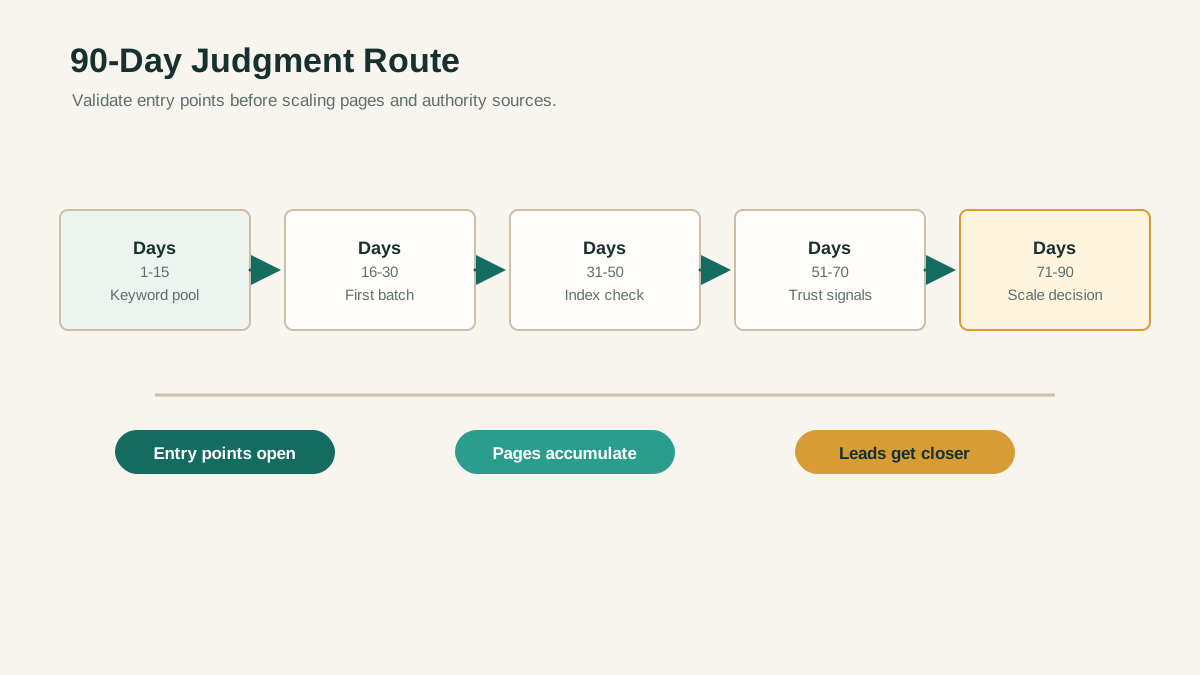
The first 90 days should diagnose the category, build the keyword map, publish sample page types, check indexation, strengthen internal links, add external trust signals, and decide what deserves scaling.
The goal is not to finish the whole system in 90 days. The goal is to prove which model works.
For a global ecommerce company, 90-day route should be treated as a business decision before it becomes a content task. The team should ask what kind of buyer this topic attracts, how close that buyer is to a real sourcing decision, and whether the official website can give that buyer a useful next step. If the answer is unclear, adding more pages will only make the site larger, not stronger.
In practical work, the useful starting point is to look for repeated patterns in growth model validation, early pages, and decision checkpoints. A page asset should not exist only because a keyword tool shows a number. It should exist because the visitor has a specific question, a specific comparison, a specific use case, or a specific buying situation that the business can answer better than a generic article.
The page then needs to connect back into the whole acquisition system. It should point visitors toward related categories, products, cases, specifications, questions, and contact actions. It should also give search engines and AI systems enough clear context to understand what the company sells, who it serves, why the page is useful, and what evidence supports the recommendation.
The common mistake is to judge 90-day route in isolation. A page may look good by itself but still fail if it has no internal links, no conversion route, no relationship to other pages, and no external trust signals. A strong official website does not win because one page is perfect. It wins because many useful pages reinforce each other over time.
The owner-level judgment is simple: keep expanding when the page type shows signs of being indexable, understandable, rankable, citable, and commercially useful. Slow down when the pages are only increasing URL count. In this playbook, scale is valuable only when it creates more valid entrances into the business.
Chapter 28: When to scale and when to adjust
Scale when a page type shows indexation, ranking movement, traffic, AI visibility, and commercial value. Adjust when pages are crawled but not indexed, indexed but not ranking, ranking but not converting, or visible but not trusted.
Stopping a weak direction is not failure. It is how resources stay focused on stronger opportunities.
For a global ecommerce company, scale decisions should be treated as a business decision before it becomes a content task. The team should ask what kind of buyer this topic attracts, how close that buyer is to a real sourcing decision, and whether the official website can give that buyer a useful next step. If the answer is unclear, adding more pages will only make the site larger, not stronger.
In practical work, the useful starting point is to look for repeated patterns in adjustment signals, page performance, and resource allocation. A page asset should not exist only because a keyword tool shows a number. It should exist because the visitor has a specific question, a specific comparison, a specific use case, or a specific buying situation that the business can answer better than a generic article.
The page then needs to connect back into the whole acquisition system. It should point visitors toward related categories, products, cases, specifications, questions, and contact actions. It should also give search engines and AI systems enough clear context to understand what the company sells, who it serves, why the page is useful, and what evidence supports the recommendation.
The common mistake is to judge scale decisions in isolation. A page may look good by itself but still fail if it has no internal links, no conversion route, no relationship to other pages, and no external trust signals. A strong official website does not win because one page is perfect. It wins because many useful pages reinforce each other over time.
The owner-level judgment is simple: keep expanding when the page type shows signs of being indexable, understandable, rankable, citable, and commercially useful. Slow down when the pages are only increasing URL count. In this playbook, scale is valuable only when it creates more valid entrances into the business.
Part 6: Turn the method into a sustainable growth rhythm
A sustainable system needs ownership, review, and a monthly operating rhythm. Without rhythm, keyword research becomes messy, pages become scattered, and reporting loses connection to decisions.
The growth rhythm should always return to the same chain: demand, pages, authority, indexation, rankings, citations, leads.
Chapter 29: Before starting, confirm six things
Confirm category demand, pageability, website conversion capacity, internal link potential, external trust potential, and team review capacity. If these are weak, fix the bottleneck before scaling.
The best projects do not start with page production. They start with a clear business diagnosis.
For a global ecommerce company, pre-start checklist should be treated as a business decision before it becomes a content task. The team should ask what kind of buyer this topic attracts, how close that buyer is to a real sourcing decision, and whether the official website can give that buyer a useful next step. If the answer is unclear, adding more pages will only make the site larger, not stronger.
In practical work, the useful starting point is to look for repeated patterns in business readiness, team alignment, and operational capacity. A page asset should not exist only because a keyword tool shows a number. It should exist because the visitor has a specific question, a specific comparison, a specific use case, or a specific buying situation that the business can answer better than a generic article.
The page then needs to connect back into the whole acquisition system. It should point visitors toward related categories, products, cases, specifications, questions, and contact actions. It should also give search engines and AI systems enough clear context to understand what the company sells, who it serves, why the page is useful, and what evidence supports the recommendation.
The common mistake is to judge pre-start checklist in isolation. A page may look good by itself but still fail if it has no internal links, no conversion route, no relationship to other pages, and no external trust signals. A strong official website does not win because one page is perfect. It wins because many useful pages reinforce each other over time.
The owner-level judgment is simple: keep expanding when the page type shows signs of being indexable, understandable, rankable, citable, and commercially useful. Slow down when the pages are only increasing URL count. In this playbook, scale is valuable only when it creates more valid entrances into the business.
Chapter 30: What a keyword library must prove
The keyword library should prove demand layers, page types, commercial value, validation priority, and scaling potential. It should not exist only as a reporting artifact.
A useful keyword library tells the team what to build next.
For a global ecommerce company, keyword proof should be treated as a business decision before it becomes a content task. The team should ask what kind of buyer this topic attracts, how close that buyer is to a real sourcing decision, and whether the official website can give that buyer a useful next step. If the answer is unclear, adding more pages will only make the site larger, not stronger.
In practical work, the useful starting point is to look for repeated patterns in demand depth, commercial value, and page opportunity. A page asset should not exist only because a keyword tool shows a number. It should exist because the visitor has a specific question, a specific comparison, a specific use case, or a specific buying situation that the business can answer better than a generic article.
The page then needs to connect back into the whole acquisition system. It should point visitors toward related categories, products, cases, specifications, questions, and contact actions. It should also give search engines and AI systems enough clear context to understand what the company sells, who it serves, why the page is useful, and what evidence supports the recommendation.
The common mistake is to judge keyword proof in isolation. A page may look good by itself but still fail if it has no internal links, no conversion route, no relationship to other pages, and no external trust signals. A strong official website does not win because one page is perfect. It wins because many useful pages reinforce each other over time.
The owner-level judgment is simple: keep expanding when the page type shows signs of being indexable, understandable, rankable, citable, and commercially useful. Slow down when the pages are only increasing URL count. In this playbook, scale is valuable only when it creates more valid entrances into the business.
Chapter 31: What page assets must prove
Page assets must prove that the site can create valid entrances, not just URLs. They need intent, structure, internal links, product paths, trust signals, and conversion routes.
If a page cannot serve a user, Google, AI, or the business, it should not be prioritized.
For a global ecommerce company, page asset proof should be treated as a business decision before it becomes a content task. The team should ask what kind of buyer this topic attracts, how close that buyer is to a real sourcing decision, and whether the official website can give that buyer a useful next step. If the answer is unclear, adding more pages will only make the site larger, not stronger.
In practical work, the useful starting point is to look for repeated patterns in unique value, search fit, and conversion role. A page asset should not exist only because a keyword tool shows a number. It should exist because the visitor has a specific question, a specific comparison, a specific use case, or a specific buying situation that the business can answer better than a generic article.
The page then needs to connect back into the whole acquisition system. It should point visitors toward related categories, products, cases, specifications, questions, and contact actions. It should also give search engines and AI systems enough clear context to understand what the company sells, who it serves, why the page is useful, and what evidence supports the recommendation.
The common mistake is to judge page asset proof in isolation. A page may look good by itself but still fail if it has no internal links, no conversion route, no relationship to other pages, and no external trust signals. A strong official website does not win because one page is perfect. It wins because many useful pages reinforce each other over time.
The owner-level judgment is simple: keep expanding when the page type shows signs of being indexable, understandable, rankable, citable, and commercially useful. Slow down when the pages are only increasing URL count. In this playbook, scale is valuable only when it creates more valid entrances into the business.
Chapter 32: Internal and external signals should raise official-site trust together
Internal links help organize authority inside the website. External sources help confirm credibility outside the website. Both are needed for a scalable official-site asset system.
The goal is to make the website easier to discover, easier to trust, and easier to cite.
For a global ecommerce company, trust signals should be treated as a business decision before it becomes a content task. The team should ask what kind of buyer this topic attracts, how close that buyer is to a real sourcing decision, and whether the official website can give that buyer a useful next step. If the answer is unclear, adding more pages will only make the site larger, not stronger.
In practical work, the useful starting point is to look for repeated patterns in internal authority, external authority, and official-site credibility. A page asset should not exist only because a keyword tool shows a number. It should exist because the visitor has a specific question, a specific comparison, a specific use case, or a specific buying situation that the business can answer better than a generic article.
The page then needs to connect back into the whole acquisition system. It should point visitors toward related categories, products, cases, specifications, questions, and contact actions. It should also give search engines and AI systems enough clear context to understand what the company sells, who it serves, why the page is useful, and what evidence supports the recommendation.
The common mistake is to judge trust signals in isolation. A page may look good by itself but still fail if it has no internal links, no conversion route, no relationship to other pages, and no external trust signals. A strong official website does not win because one page is perfect. It wins because many useful pages reinforce each other over time.
The owner-level judgment is simple: keep expanding when the page type shows signs of being indexable, understandable, rankable, citable, and commercially useful. Slow down when the pages are only increasing URL count. In this playbook, scale is valuable only when it creates more valid entrances into the business.
Chapter 33: What to review every month
Monthly review should cover new keywords, new pages, indexation, ranking pool growth, organic traffic, AI mentions or citations, inquiries, quotes, and page-type performance.
The review should decide what to scale, what to improve, and what to pause.
For a global ecommerce company, monthly operating rhythm should be treated as a business decision before it becomes a content task. The team should ask what kind of buyer this topic attracts, how close that buyer is to a real sourcing decision, and whether the official website can give that buyer a useful next step. If the answer is unclear, adding more pages will only make the site larger, not stronger.
In practical work, the useful starting point is to look for repeated patterns in growth review, quality review, and decision review. A page asset should not exist only because a keyword tool shows a number. It should exist because the visitor has a specific question, a specific comparison, a specific use case, or a specific buying situation that the business can answer better than a generic article.
The page then needs to connect back into the whole acquisition system. It should point visitors toward related categories, products, cases, specifications, questions, and contact actions. It should also give search engines and AI systems enough clear context to understand what the company sells, who it serves, why the page is useful, and what evidence supports the recommendation.
The common mistake is to judge monthly operating rhythm in isolation. A page may look good by itself but still fail if it has no internal links, no conversion route, no relationship to other pages, and no external trust signals. A strong official website does not win because one page is perfect. It wins because many useful pages reinforce each other over time.
The owner-level judgment is simple: keep expanding when the page type shows signs of being indexable, understandable, rankable, citable, and commercially useful. Slow down when the pages are only increasing URL count. In this playbook, scale is valuable only when it creates more valid entrances into the business.
Chapter 34: Team roles that keep the project from scattering
Strategy owns category judgment and priorities. Content owns page usefulness and structure. Technical work owns crawlability and scalable publishing. Link and source work owns trust signals. Sales or growth owns conversion feedback.
When nobody owns the whole chain, the project fragments.
For a global ecommerce company, team roles should be treated as a business decision before it becomes a content task. The team should ask what kind of buyer this topic attracts, how close that buyer is to a real sourcing decision, and whether the official website can give that buyer a useful next step. If the answer is unclear, adding more pages will only make the site larger, not stronger.
In practical work, the useful starting point is to look for repeated patterns in content ownership, technical ownership, and commercial ownership. A page asset should not exist only because a keyword tool shows a number. It should exist because the visitor has a specific question, a specific comparison, a specific use case, or a specific buying situation that the business can answer better than a generic article.
The page then needs to connect back into the whole acquisition system. It should point visitors toward related categories, products, cases, specifications, questions, and contact actions. It should also give search engines and AI systems enough clear context to understand what the company sells, who it serves, why the page is useful, and what evidence supports the recommendation.
The common mistake is to judge team roles in isolation. A page may look good by itself but still fail if it has no internal links, no conversion route, no relationship to other pages, and no external trust signals. A strong official website does not win because one page is perfect. It wins because many useful pages reinforce each other over time.
The owner-level judgment is simple: keep expanding when the page type shows signs of being indexable, understandable, rankable, citable, and commercially useful. Slow down when the pages are only increasing URL count. In this playbook, scale is valuable only when it creates more valid entrances into the business.
Chapter 35: Before launch, confirm the site behaves like an acquisition system
The site should have entrances, page roles, search-and-AI structure, commercial paths, internal links, external trust signals, and language consistency. If it still feels like a product shelf, it is not ready to scale.
The launch question is simple: can this site help buyers find, trust, and contact the company?
For a global ecommerce company, launch readiness should be treated as a business decision before it becomes a content task. The team should ask what kind of buyer this topic attracts, how close that buyer is to a real sourcing decision, and whether the official website can give that buyer a useful next step. If the answer is unclear, adding more pages will only make the site larger, not stronger.
In practical work, the useful starting point is to look for repeated patterns in site behavior, page paths, and lead capture. A page asset should not exist only because a keyword tool shows a number. It should exist because the visitor has a specific question, a specific comparison, a specific use case, or a specific buying situation that the business can answer better than a generic article.
The page then needs to connect back into the whole acquisition system. It should point visitors toward related categories, products, cases, specifications, questions, and contact actions. It should also give search engines and AI systems enough clear context to understand what the company sells, who it serves, why the page is useful, and what evidence supports the recommendation.
The common mistake is to judge launch readiness in isolation. A page may look good by itself but still fail if it has no internal links, no conversion route, no relationship to other pages, and no external trust signals. A strong official website does not win because one page is perfect. It wins because many useful pages reinforce each other over time.
The owner-level judgment is simple: keep expanding when the page type shows signs of being indexable, understandable, rankable, citable, and commercially useful. Slow down when the pages are only increasing URL count. In this playbook, scale is valuable only when it creates more valid entrances into the business.
Chapter 36: When traffic arrives, connect it to consultation
Visitors need different next steps depending on where they are: learning, comparing, sourcing, or ready to buy. Do not send every page to the same generic contact button.
Content pages should lead to products or solutions. Product pages should lead to quotes or purchases. Supplier pages should explain cooperation paths.
For a global ecommerce company, traffic conversion should be treated as a business decision before it becomes a content task. The team should ask what kind of buyer this topic attracts, how close that buyer is to a real sourcing decision, and whether the official website can give that buyer a useful next step. If the answer is unclear, adding more pages will only make the site larger, not stronger.
In practical work, the useful starting point is to look for repeated patterns in consultation path, sales handoff, and lead qualification. A page asset should not exist only because a keyword tool shows a number. It should exist because the visitor has a specific question, a specific comparison, a specific use case, or a specific buying situation that the business can answer better than a generic article.
The page then needs to connect back into the whole acquisition system. It should point visitors toward related categories, products, cases, specifications, questions, and contact actions. It should also give search engines and AI systems enough clear context to understand what the company sells, who it serves, why the page is useful, and what evidence supports the recommendation.
The common mistake is to judge traffic conversion in isolation. A page may look good by itself but still fail if it has no internal links, no conversion route, no relationship to other pages, and no external trust signals. A strong official website does not win because one page is perfect. It wins because many useful pages reinforce each other over time.
The owner-level judgment is simple: keep expanding when the page type shows signs of being indexable, understandable, rankable, citable, and commercially useful. Slow down when the pages are only increasing URL count. In this playbook, scale is valuable only when it creates more valid entrances into the business.
Chapter 37: How long-form guides, knowledge bases, and website pages amplify each other
A complete guide builds the system view. Knowledge base pages capture specific searches. Case pages prove capability. Product and service pages capture business demand.
Together they create a website content network rather than isolated content pieces.
For a global ecommerce company, content ecosystem should be treated as a business decision before it becomes a content task. The team should ask what kind of buyer this topic attracts, how close that buyer is to a real sourcing decision, and whether the official website can give that buyer a useful next step. If the answer is unclear, adding more pages will only make the site larger, not stronger.
In practical work, the useful starting point is to look for repeated patterns in long-form guide, knowledge base, and website pages. A page asset should not exist only because a keyword tool shows a number. It should exist because the visitor has a specific question, a specific comparison, a specific use case, or a specific buying situation that the business can answer better than a generic article.
The page then needs to connect back into the whole acquisition system. It should point visitors toward related categories, products, cases, specifications, questions, and contact actions. It should also give search engines and AI systems enough clear context to understand what the company sells, who it serves, why the page is useful, and what evidence supports the recommendation.
The common mistake is to judge content ecosystem in isolation. A page may look good by itself but still fail if it has no internal links, no conversion route, no relationship to other pages, and no external trust signals. A strong official website does not win because one page is perfect. It wins because many useful pages reinforce each other over time.
The owner-level judgment is simple: keep expanding when the page type shows signs of being indexable, understandable, rankable, citable, and commercially useful. Slow down when the pages are only increasing URL count. In this playbook, scale is valuable only when it creates more valid entrances into the business.
Chapter 38: Turn one guide into a continuously updated knowledge base
A knowledge base should be built around real buyer questions: selection, scenarios, compatibility, care, installation, comparison, procurement, delivery, and trust.
It should not be a blog archive. It should be a structured extension of the official website asset system.
For a global ecommerce company, knowledge base expansion should be treated as a business decision before it becomes a content task. The team should ask what kind of buyer this topic attracts, how close that buyer is to a real sourcing decision, and whether the official website can give that buyer a useful next step. If the answer is unclear, adding more pages will only make the site larger, not stronger.
In practical work, the useful starting point is to look for repeated patterns in guide updates, content reuse, and asset compounding. A page asset should not exist only because a keyword tool shows a number. It should exist because the visitor has a specific question, a specific comparison, a specific use case, or a specific buying situation that the business can answer better than a generic article.
The page then needs to connect back into the whole acquisition system. It should point visitors toward related categories, products, cases, specifications, questions, and contact actions. It should also give search engines and AI systems enough clear context to understand what the company sells, who it serves, why the page is useful, and what evidence supports the recommendation.
The common mistake is to judge knowledge base expansion in isolation. A page may look good by itself but still fail if it has no internal links, no conversion route, no relationship to other pages, and no external trust signals. A strong official website does not win because one page is perfect. It wins because many useful pages reinforce each other over time.
The owner-level judgment is simple: keep expanding when the page type shows signs of being indexable, understandable, rankable, citable, and commercially useful. Slow down when the pages are only increasing URL count. In this playbook, scale is valuable only when it creates more valid entrances into the business.
Chapter 39: In the first 30 days, watch early signals
Do not judge success too early, but start observing immediately. Check usability, entry points, user behavior, content gaps, internal links, and consultation signals.
The first month is for small corrections, not panic.
For a global ecommerce company, first 30 days should be treated as a business decision before it becomes a content task. The team should ask what kind of buyer this topic attracts, how close that buyer is to a real sourcing decision, and whether the official website can give that buyer a useful next step. If the answer is unclear, adding more pages will only make the site larger, not stronger.
In practical work, the useful starting point is to look for repeated patterns in early signals, indexation and behavior, and course correction. A page asset should not exist only because a keyword tool shows a number. It should exist because the visitor has a specific question, a specific comparison, a specific use case, or a specific buying situation that the business can answer better than a generic article.
The page then needs to connect back into the whole acquisition system. It should point visitors toward related categories, products, cases, specifications, questions, and contact actions. It should also give search engines and AI systems enough clear context to understand what the company sells, who it serves, why the page is useful, and what evidence supports the recommendation.
The common mistake is to judge first 30 days in isolation. A page may look good by itself but still fail if it has no internal links, no conversion route, no relationship to other pages, and no external trust signals. A strong official website does not win because one page is perfect. It wins because many useful pages reinforce each other over time.
The owner-level judgment is simple: keep expanding when the page type shows signs of being indexable, understandable, rankable, citable, and commercially useful. Slow down when the pages are only increasing URL count. In this playbook, scale is valuable only when it creates more valid entrances into the business.
Chapter 40: Long-term growth comes from expanding high-value page assets
Long-term growth comes from scaling validated topics, industries, questions, and conversion paths. New content should add search entrances, trust, AI readability, or business paths.
If new content does none of those things, it should not be the priority.
For a global ecommerce company, long-term growth should be treated as a business decision before it becomes a content task. The team should ask what kind of buyer this topic attracts, how close that buyer is to a real sourcing decision, and whether the official website can give that buyer a useful next step. If the answer is unclear, adding more pages will only make the site larger, not stronger.
In practical work, the useful starting point is to look for repeated patterns in page asset expansion, compounding authority, and sustainable acquisition. A page asset should not exist only because a keyword tool shows a number. It should exist because the visitor has a specific question, a specific comparison, a specific use case, or a specific buying situation that the business can answer better than a generic article.
The page then needs to connect back into the whole acquisition system. It should point visitors toward related categories, products, cases, specifications, questions, and contact actions. It should also give search engines and AI systems enough clear context to understand what the company sells, who it serves, why the page is useful, and what evidence supports the recommendation.
The common mistake is to judge long-term growth in isolation. A page may look good by itself but still fail if it has no internal links, no conversion route, no relationship to other pages, and no external trust signals. A strong official website does not win because one page is perfect. It wins because many useful pages reinforce each other over time.
The owner-level judgment is simple: keep expanding when the page type shows signs of being indexable, understandable, rankable, citable, and commercially useful. Slow down when the pages are only increasing URL count. In this playbook, scale is valuable only when it creates more valid entrances into the business.
Appendix: Expansion judgment for four common industry types
Standard ecommerce categories are usually easier to scale when the product range is broad, the attributes are clear, and buyers search with many modifiers. A category with sizes, colors, materials, specifications, compatibility needs, bundles, or use cases can usually create many valid page entrances. The risk is duplication. If every page only changes a few words, the site may grow in URL count without growing in value. The better approach is to use product attributes, buyer scenarios, and comparison intent to give each page a clear reason to exist.
Custom product categories need a different judgment. The opportunity often sits in applications, industries, projects, buyer problems, and decision criteria rather than simple product names. These pages should not read like generic category pages. They should explain where the product is used, what decisions buyers need to make, what trade-offs matter, what proof the supplier can provide, and how the visitor can move toward a consultation or quote. For custom products, page assets work best when they turn vague interest into a structured buying discussion.
B2B factory and export manufacturing categories should judge scale through commercial depth rather than traffic size alone. A keyword with modest volume can still be valuable if the buyer is looking for a manufacturer, supplier, OEM partner, wholesale quote, or private-label solution. These pages need stronger company proof, production capability, certifications, cases, process clarity, and contact paths. For this type of company, the official website citation rate can become especially meaningful when the site has enough authoritative pages and external trust signals.
Parts, accessories, and replacement categories often scale through long-tail precision. Buyers may search by model, year, device, part number, fitment, failure symptom, compatibility, or installation problem. These pages are useful when they reduce uncertainty. The page should help the visitor confirm fit, understand the difference between similar options, and reach the right product or inquiry path quickly. This is one of the clearest examples of why keyword volume and page volume need to work together.
The practical judgment is that industry type changes the page model. A brand should not copy the same page logic across every category. The right question is: where does this buyer experience uncertainty before purchase, and can the official website turn that uncertainty into a searchable, rankable, citable, and convertible page asset?
Appendix: How owners and growth leaders should judge whether this is worth doing
The owner should not start by asking how many articles the team can publish. The better question is whether the business has enough repeatable demand to justify a page-asset system. If the category has keyword depth, commercial long-tail intent, differentiated products, useful cases, and a website that can convert visitors into inquiries, the opportunity is worth serious evaluation.
The second judgment is whether the company can keep quality while increasing volume. This does not mean writing every page manually forever. It means having a controlled structure: clear page types, valid keyword groups, useful differentiation fields, internal links, external trust signals, and a review rhythm. Scaling works when the system expands proven page patterns. It fails when the team creates pages before understanding demand.
The third judgment is whether the website is prepared to become an acquisition system. A page that ranks but cannot move the visitor toward a product, quote, distributor conversation, sample request, or consultation will waste search visibility. Before scaling, the owner should check whether product pages, category pages, contact paths, case proof, company proof, and sales follow-up can support the traffic that arrives.
The fourth judgment is whether the company understands the role of SEO and AI search visibility together. Organic search is still a major source of overseas buyer intent. AI search visibility is not a replacement for SEO; it is another discovery and recommendation layer built on pages, sources, structure, and trust. A company that builds high-value official website pages can serve both paths with the same asset base.
The final judgment is timing. If the company has no clear product positioning, no reliable product information, no conversion path, and no one responsible for maintaining the system, it should pause and prepare. If the company already has demand, products, proof, and a willingness to build page assets over time, this system can become one of the strongest long-term channels for acquiring overseas customers.
Appendix: Common mistakes to avoid before publishing
Do not reduce SEO to article writing. Do not turn AI search visibility into a separate buzzword project. Do not treat URL count as page assets. Do not build keyword libraries only for reporting. Do not watch traffic while ignoring leads.
Also avoid promising official-site citation rates as guarantees. A high official-site citation share is a goal and validation signal when the site has enough page assets, structure, trust, and external source consistency.
The biggest publishing mistake is to treat this project as a one-time ebook or a one-time SEO campaign. The guide may attract attention, but the website pages must do the long-term work. If the keyword library is shallow, if the page assets do not connect to products, or if the site has no credible contact path, the ebook will create interest that the website cannot capture.
Another mistake is giving away every operational detail while failing to sell the strategic judgment. A useful lead magnet should help the reader understand why the system matters, what decisions they need to make, and what risks they should avoid. It should not become a free implementation course that removes the need for expert diagnosis.
Teams also go wrong when they separate organic search, AI search visibility, content, links, and conversion into different projects. In the official website environment, these are not separate growth tracks. The same page can match a keyword, answer a buyer question, earn an internal link, attract an external mention, become an AI-citable source, and move the visitor toward consultation.
Before publishing, review the manuscript and the website together. The ebook should create desire to understand the method, while the website should prove that the company can execute the method. When those two assets support each other, the guide becomes more than content. It becomes the front door to a serious acquisition system.
Conclusion: The official website must become an acquisition system
The future global ecommerce site is not only a product shelf. It is a search entrance, a trusted information source, an AI-citable knowledge base, and a conversion path.
The companies that win will be the ones that turn products, scenarios, problems, regions, and purchasing intent into structured official website assets that can compound over time.
The practical conclusion is not that every company should chase AI search as a new trend. The stronger conclusion is that a company that already builds useful, structured, trustworthy official website pages is preparing for both organic search and AI-assisted discovery. The same asset can bring a Google visitor today and become a source that an AI answer references tomorrow.
For overseas ecommerce, this matters because search demand is still one of the largest pools of buyer intent. Buyers search before they compare, compare before they contact, and contact only when the website gives them enough confidence. AI search does not remove that process. It changes how some users discover, summarize, and verify sources. The official website still needs to be visible, understandable, credible, and useful.
This is why page volume matters, but only when the pages are real assets. Keyword volume creates opportunity. Page assets create entrances. Internal links create structure. External links and source mentions create trust. Indexation and rankings create visibility. AI citations create another discovery layer. Conversion paths turn the whole system into leads and orders.
A company that understands this will not ask whether it should do SEO or AI search visibility. It will build the website in a way that serves both. That is the two-way acquisition model: one official website system, many keyword entrances, many high-value pages, shared authority signals, and continuous growth through pages that buyers and machines can both trust.
Want to know if your category can scale through organic search and AI search visibility?
Put keyword demand, page assets, internal links, external trust signals, indexation, rankings, AI citations, and conversion paths into one view. The answer becomes much clearer.